Disaster Preparedness
Tsunami Intervetion Program Supported By Christian Aid
As a result of previous Tsunami relief and rehabilitation interventions we identified the vulnerable and socially excluded families/communities, who are dependent on wage labour on the fishing boats, un-organised sectors and agricultural communities, which are, missed out from the rehabilitation interventions. We further worked closely with them using participatory approaches to sharpen our understanding of their livelihood system and possible interventions. In this process we identified some of the issues among dalits, single women and especially with children from DRR perspectives.
SPEECH started its partnership with Christian Aid on food security issues of dry land agriculture, especially among small and marginal farmers and land based agri labourers given the trend of climate crisis, its link with disaster risk and possible impact on the vulnerable communities. It is obvious lots of the existing or proposed solutions are not designed from local perspective. There is a wide gap between the need and proposed solutions due to lack of better understanding of local knowledge on mitigation, coping mechanism and its impact. Thus policies introduced by various stake holders and NGO sector are not in the same comprehendible wave length of the vulnerable groups.
The earlier intevention of building capacity among school children and the system in Nagapattinam have proved very meaningful and had its own impact on the communities through children especially in the recent floods. To a great extent life and asset loss is considerable reduced due to the knowledge gained by the children as well the CBDP task force. Given the impact there is a great need to scale up the process with in Nagai and other districts as well institutionalize the concept within the mainline school system.
The fragile livelihood system of dalit farmers in the bordering panchayats of Nagai district, which is almost on the verge of eviction of these tenant families by the landlords. SPEECH is already working with this issue in partnership with SCIAF to strengthen/create a platform for negotiations with the landlords and to ensure food security. Though the platform is strengthened and working on a dialogue stage there is a clear need to support these families with partial investment costs to regain their confidence.
Further there is a clear need to work jointly with like minded partners and CBOs to make the interventions a reality and push through the government policies. This requires appropriate advocacy and lobby forum and joint action.
Having passed four years after tsunami, the Nagai communities have come across many players from National. International NGOs, government system and individuals. There are many lessons learned in the inclusion process both positive and negative, especially with dalits, adivasies and within women and children. As days go by these valusble experience wither and buried within few minds of people and not put to use for future consideration. Thus there is a great need to document few positive and negative experiences of social exclusion, advocacy, islands of success, dos and donts in a documented version.
Thus it is proposed to do this study using the existing children panchayats (adolescent children)with appropriate orientation. This will serve as direct learning for children who are the key targets of vulnerability to the current growing climate crisis and draw from local knowledge expertise. On the other hand the outputs will be used for building capacity of the vulnerable to resist, lobby against the imposition. Also the findings will be shared with key stakeholders.
It is proposed to scale up the current work of introduction of school safety concepts Which we have done 15 schools of Nagapattinam, scale up to 150 schools spread over three districts of Tamilnadu to create capacity among children and through them their Families and communities in relation to disaster preparedness. Alongside we propose to work closely with line department to activate school safety concerns within regular School educational curriculum.
The other special focus that s on a sustainable basisthese communities to strengthen their landrighis needed urgently is giving network support to the scavenging group/families who are marginalized and are represented by a fellow NGO.
What has been the impact of integrating the Code of Conduct into your response?
- Most vulnerable people such as four physically challenged and four single women have gained acceptance Since they own permanent shelters and inaugurated by Nagapattinam MP. Mr. AKS Vijayan.
- Hope regained by 70 dalit families through the reconstruction of houses .(Due to Labour insufficiency , Thiruchendur house construction process is little bit slow, soon we will sort it out this problem)
- 60 migrant families of Velankanni have permanently settled and making a joyful living
- Through our intervention , the level of self confidence boosted up among Single women and disabled families of dalits
- The attitude of dominating the women is comparatively reduced among village youths and elders importance is given to respect the feelings of disabled and single women
- Increased acceptance among relatives and communities for Single women and disabled family members.
- Children know about the current impact of ‘Climate Crisis’ and how it will affect the younger generation and Mitigation process understood by children.
- Village level farmers and SHG members gained knowledge on organic farming, value addition to agri products and economical benefit .
- Farmers gained knowledge on agricultural related government subsidies and established good rapport with agriculture department.
- First generation dalit children continuing their higher studies
- Dalit and vulnerable communities of the target area members are well equipped to respond to any emergencies in their area. (last flood relief time our CBDP committee members have provided 3 day meals to flood victims)
- 3 District level administration adopted school safety program and they given official approval to all the school head masters to implement the school safety concepts
- District level Administration, Educational officers and Head Masters Aware and quite interested to implement School safety program in 3 districts , Nagapattinam, Virudhunagar and Ramanathapuram
- 50 dalit farmers leased in land for their own cultivation. These families have gained self respect among other communities. Constant income source stabilized for them.
- Climate crisis study report well documented ..
- Documentation of 30 Success stories on Tsunami and lessons learnt on social inclusion humanitarian
Building on Local Capacity
- 173 families have become self dependent / reliant
- Increased income level to the families
- Bargaining capacity of target group increased
- Established linkages
- Local committees strengthened to resolve conflicts
- Discrimination reduced among single women and disable families
- Children’s knowledge increased on Disaster and Climate Crisis through supply of play way materials, conducting awareness classes, mock drill and studies.
- Govt. officials and local bodies focus increased on disasters by our interventions
- Property ownership increased among beneficiaries
- 3 district level children club members are well aware about climate change impacts.
- 34289 children and 996 teachers know about disaster mitigation and preparedness strategies through School Safety Programme among in three districts.
- 300 sets of Climate change study, Social inclusion case study reports were distributed to NGOs. INGOs, Education institutions and Government department
Learning Lessons
- Intensive plans for disaster mitigation programs and demonstration of mock drills in coastal villages
- Formation of different committees such warning, rescue, first aid and Shelter management committees among our target area.
- Federating the dalits at block level and affiliating with other allies.
- School safety programme creates awareness among students and school administrations.
- Established inter-link between Schools and other resource departments.
- Children ( Pallar Panchayat) expressed their knowledge, interest and abilities on Climate crisis
- Ensure monitoring committees to involve in all project level implementation process
Tsunami Intervetion Program Supported By SCIAF
SPEECH was involved in revival of traditional livelihood activities and motivated the affected Dalit farmers because they are depending upon the Agriculture based livelihoods. SPEECH in collaboration with Tamil Nadu Agriculture University and given a opportunity to interact with expert agriculture officer and they have learnt how to reform their cultivation methods and the farmers to get high yield from land. By using training experience and using organic manure in their salinated land and change the land into a fertile one. Cultivation expenses has reduced substantially by using bio-manure ( Vemi compost ) This year 25 persons belong to Gramathumedu and Pologam village have produced vermin compost manure and they have used in their Agricultural fields
Two years before, Dalit farmers borrowed money with high interest rate to get chemical fertilizer. Now they know how to prepare bio- manure and avoid borrowing money for high interest rate from money lenders, under the guidance of SPEECH. We have provided financial assistance to agriculture activities through women federation. 50 dalit farmers have got assistance for land cleaning, ploughing and bunding in their fields.
Excess water usage distribution regulated though construction of Small size Sluices, and desilting of feeding channel. 440 Mts. Canal desilted and 11 sluices constructed. By this programme, 245 farmers (750 acres) got equal water distribution and avoided water wastage. By way of deepening of four ponds in Gramathumedu and Melavanjure villages, the water storage capacity have increased which is used for agriculture and domestic purposes.
SPEECH has created awareness on child’s health and Nutrition among SHG members and provided nutritional supplement to pregnant women and lactating mothers. With financial and technical support form SPEECH almost all the families in Gramathumedu and Pologam villages have established homestead kitchen gardens and taken a very good yield . Moreover fresh vegetable has been added to every meal impacted in family nutrition. In addition, SPEECH has provided useful saplings and shadow giving saplings to the people. Sending the children to higher studies has been a crucial issue in the coastal areas. However through the SHG the children were motivated to continue their higher education with our financial assistance. As of now 38 children are continuing their Higher Education.
We have also provided education materials like books, notes, pen, pencils, etc. to 1100 students and motivated them to continue their studies. Various academic related competitions are conducted to students from time to time. This has been very useful to the students for exposing their talents and skills. Such activities have given good opportunity to develop student’s talents and it gives more pleasure to their parents.
At Gramathumedu, drinking water availability was very poor All the families were purchasing drinking water from outside. The ground water salinity is very high so bore-wells cannot be used in this area. The Govt.Primary and High school students use the open pond water for drinking and school noon meal preparation. In this critical situation, most of the children are affected by water borne diseases and school absentees have increased. We have discussed the above said problem with the community representatives, the Govt. officials (Block Development Officer-BDO), and the School Head Master, we established the “Water Purification Unit “ in the school premises. 1250 children are benefitted out of this project.
SPEECH has given various training programmes for women’s self help group on how to interact mutually with other groups and to sustain unity among themselves. We motivated the women’s SHG to involve themselves in public service activities and to solve the basic problems.. We extended financial support for newly formed small scale micro economic development groups and motivated the SHG members. They have now learnt new skills to have additional income sources and have developed their self – confidence. Now they are living with dignity in society and have developed their talent for maintaining their status in society. SPEECH has given necessary talent oriented training to the members of the federation and the women’s federations interlinked with other Networks,
In future, the Block level Women Federation would take care of the all the SHG’s activities like, trainings, establishments of linkages with bank and other institutions. It will lead all the women and children issues.
Through our innovative disaster preparedness programme, we introduced a new model of the “School Safety Programme” in 10 schools. We conducted Mock drills and the safety club formation has been one of the major activities of this programmes. 2608 children participated in good we would established safety clubs to be utilised effectively during any emergency. The administration of the schools and district administration have appreciated our efforts. In addition, we have conducted Campaigns, Trainings and Seminar on Climate Change and Global warming for PRI members, youth and SHG members.
Outcome:
- 50 Dalit farmers in Gramathumedu and polagam villages brought back the land in to cultivation and increased their production.
- 440 Mts feeding channel- desilted and cement slab fixed at Gramathumedu.245 farmers (750 acres) benefited.
- 4 ponds desilted and water storage capacity increased.
- 30 progressive farmers in polagam Gramathumedu and villages practicing organic farming methods.
- Animal Health improved through mass contact program.
- Through our organic agriculture trainings, 10 farmers established Vermi compost pit and 15 farmers established compost pit at their backyard of the houses with the assistance of SPEECH
- 78 farmers established linkage with Block level Government Agriculture department
- Linkages established with nearby model farmers with the help of Government Agriculture Department.
- 116 Village level farmers have trained in alternate livelihood concepts.
- 39 progressive farmers trained on organic fertilizer and pesticide preparation methods.
- 38 farmers association members trained with alternate crop cultivation
- Construction of 25 Individual Toilets in Gramathumedu and Pologam village and hygiene practices inculcated.
- 210 family vegetable needs met at the doorstep and health improved.
- 330 children and 32 pregnant mothers are benefited through supply of Nutrition supplements.
- 100 members expanded their knowledge base on HIV/AIDS, Environmenal Sanitation. Adolescent’s personal hygiene.
- Installation of 1 safe drinking water purification unit for school children regular usage at Gramathumedu village
Case Study- 1
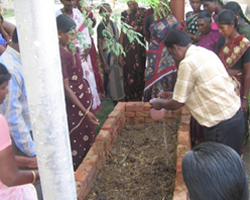
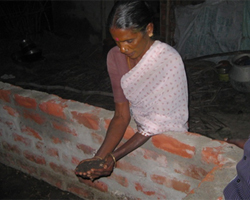
Vermi compost preparation
 |
 |
Vermi Compost Demonstrated by SPEECH staff |
Beneficiary Mrs. Sivakami Valli |
Dalit families who are living in Gramathu medu Village, mostly depending on agriculture for their livelihoods.
My name is Sivakami Valli and my husband name is Muthukumarasamy we have one son Kamugan 25 years old and he is studying M.Com in Annamali university through distance education and my daughter Manimozhli age 20 B.A Blit.
We have two acres of land and we depend on these lands for our livelihoods. At the time of Tsunami our lands was affected by inflow of sea water and it is silted with salt. We used mainly natural manure for our agriculture. SPEECH Organization who alone worked for the economical and social uplift of the Dalits, trained us the technology of vermi compost to increase yield in our harvest. They gave us training with the help of K.V.K Agriculture research institute through our self help groups.
Apart from this we are also aware of this new technology through newspaper and T.V media at last we had a mind to try out with this new technology, we discussed this is in the our regular monthly meetings and at last communicated the information to SPEECH organization. Then the organization demonstrated the way of developing vermi compost with help of agriculture research institute.
The organization constructed vermi beds of 8 ft length 3ft width and 4ft height they supplied all the necessary materials worth of Rs. 5,000/-, we also collected the raw materials like cow dung, leaves etc., SPEECH had constructed 10 vermi beds for 10 progressive formers they also supplied earth worms 2kg per beds which cost Rs. 350/-
We are following the instructions given by Agriculture research institute in maintaining the vermi compost while adding the worms. We should always add dried cow dung other wise the worm will die, if we add wet cow dung. This organic manure will be ready after 45 days we should stop watering the compost and can collect the readily available in a bag after 5 days. Since the compost is dry the worm will reside underneath and ready for next harvest. We tried this compost in our garden we find the difference in the yield. We are very much impressed with this vermi compost and planning to use for our agricultural farming. Now we have started developing this organic manure regularly.
We are really thankful to SPEECH and SCIAF for opening our eyes to this new technology.
Increasing Crop Yield by Improving Irrigation for Poor Farmers
The irrigation canal at Gramathumedu village was lying dead from a long time and crop yield continue to decrease due to fall in crop production. The crops were not getting proper water due to the nonfunctional canal. This resulted in poor farmers being driven down further in poverty and knocking the doors of money lenders who charge phenomenal interest in borrowings.
The defunct irrigation canal had to be revived, desilted, cleaned and fitted with sluice gates for proper irrigation of crops to increase the yield.
Who: For the poor farmers of Gramathumedu village. The awareness was conducted for farmers on importance of irrigation for increasing crop yield.
Why: The farmers are dependent on this farms for their livelihood. It is essential to crop yield which also provides abundant fodder for cattle. Due to erosion of top soil, strength of farm lands decrease over a period of time. This results in yield decrease and poor farmers commence borrowing money at high interest rates in the nearest town of Valankanni. In order to avoid poor farmers from becoming poorer, it was decided to strengthen the farmlands and boost up the yield by improving the irrigation facilities to the farms.
What: A meeting was held with the poor farmers and they themselves pointed out the necessity to increase water for their farms to step up the yield. They agreed to clean and desilt the already existing canal. The farmers requested us to assist them in fitting the required number of sluice gates in the canal for proper distribution of water.
Where: At village Gramathumedu Training on necessity of water for increasing crop yield and reason for fitment of sluice gates was conducted.
When: On completion of the paddy season when the farmers venture out for daily wage labour in nearby towns. During this period training for strengthening the land, requirement of water for crops, reduction of salinity and factors that increase crop yield.
How: The process in detail was discussed with Panchayat members, Village elders, Youth groups and SHG members. Trainings were held for these members on
- Soil Erosion
- Increasing strength of farmlands
- Reasons for decrease in crop yield
- Importance of water
Gramathumedu is a village is situated three kilometers west to Vailangkanni town. These are 125 poor families residing in the village. The main occupation of the villagers is farming. During off paddy season, these poor farmers carry out basket weaving, brick
works, carpenter work and construction work helpers in nearby season, these farmers carry out the following activities.May – June Due to onset on monsoon, the farmlands are prepared compost pits are activated for production of organic fertilisers.
June – July Far lands are cleaned and paddy seeds are prepared for sowing
July – August Farmlands are ploughed
August – September Paddy mother beds are prepared after the paddy seeds.
September – October Paddy transplantation is carried out Organic fertiliers are spread in the fields.
October – November Organic fertilisers and pesticides are sprayed in the paddy fields.
November – December Crop harvesting is carried out Paddy is removed and packed in gunny bags
Problems in the Irrigation Canal
The following canals in the village are used for irrigation
- Perriya Vaikkkal
- Perriya Pudingki Vaikkal
- Ommaikulam Vaikkal
The existing problems are as follows
- The canals are very narrows
- Uneven flows of water within the canal
- Due to lack of proper bunds, a lot of sand flows in the canal which prevents smoothes passage of water
- Lot of rain water wastage during monsoons.
Periya Vaikkal – 4
Periayapudinki vaikkal – 4
Ommaikulam vaikkkal – 3
Total gates required – 11
The farmers during meeting agreed to clean desilt all the three canals. They requested us to fit the eleven sluice gates the correct positions. The farmers accepted the responsibility to clean, desilt and maintain the three canals. They promised to maintain these three canals in future. When functional, the canals supplies water to 424 acres of paddy land benefitting 136 families.
Impact of the Program
The reconstruction, repair, desilitng and fitment of the three canals resulted in the following
- The yield of 424 of paddy land increased sustainably thereby benefitting 136 poor families.
- Silting within the canal has ceased which is observed by the even flow of water.
- Farmlands contain the desired moisture during the paddy season.
- Good quality of water is now available to the crop.
- Brought about a sense of responsibility and duty amongst the farmers to maintain the smooth flow of water in the canals.
- Increase in valve of the lands.
- Encouraged farmers to take more interest in farming rather than giving their lands on lease.
- Awareness about organic farming increased amongst our farmers
Tsunami Intervetion Program Supported By CCFC
SPEECH and the target community:
Followed by a serious fire accident at the temporary shelters of Melapattinacherry fishing community – a transit camp wherein tsunami victims were accommodated – they are moved to safer places. SPEECH is working with the fishing community in partnership with CIDA and in one such filed visits the plight of the gypsies was brought to our notice by one of the women self help group from the fishing community. On hearing the information our field staff visited the clan and conducted participatory sessions with the children and adults from gypsy families. It is amazing to know that the families had very vast wider dreams about their future and are seriously shaken by the tsunami incidence. Since we did not have sufficient fund possibilities, we approached one of the fellow NGO to assist the Narikuravas with temporary shelters. Having settled them in safe temporary shelters, we sought assistance from CIDA to support the gypsy children to admit in local schools and extend immediate support for the women to resume their small business to ensure food security.
Having started partnership in the rehabilitation process of gypsies we approached local government to assist the families with allocation of land for construction of permanent shelters. Our repeated representation made it possible for the gypsies to get provision of construction site allotted by the government. On receiving we approached CCFC for assistance in construction of permanent shelters to all the 22 families and continued support for the children and women/families with alternate livelihood options.
Our intervention with the target group had the following short term objectives:
- To assist 22 Narikurava tsunami victim families with provision of permanent shelter in an area that is allocated by District Administration;
- To support 18 children who are first generation scholars from Narikurava families with educational and health support;
- To strengthen women through formation of self-help group (20 women in total) to improve their micro entrepreneurial skills and expand their working capital
- To assist the families with capacity building processes to better access government support and development options
- To evolve localized participatory co-ordination and monitoring system to address marginalization from priority sector.
Construction of Permanent shelters:
On getting assurance from CCFC we have negotiated with the beneficiary families using PRA tools to better understand their perception of permanent shelters, their life style and provisions they visualize to have in their houses. It is amazing to see children in the community had much wider perception than adults to include a health post, temple and sanitary facilities. This is a clear indicator that the changing times and exposure was clearly depicted in the diagrams.
While initiating the construction process, SPEECH followed systematic norms as prescribed by the Government in the memorandum of understanding.
- As per the government guidelines the permanent shelters should be of a minimum size of 300 sq. ft.
- The list of beneficiaries will be finalysed by the government and the NGOs should surrender the houses only to the district administration and not to the individual beneficiaries directly.
- The construction process, material used in construction process, and ration of cement and mortar all should be as per the technical specification of the government and there will be a specialist team periodically visiting the work.
- Soil, water and strength of the brick should be tested and report of the same should be submitted to the government.
- Government will support with support infra structures such as connecting roads, drainage, electricity, drinking water, etc.
While accepting the government norms we have incorporated the expectations of the beneficiaries within the limitations and overall framework. The local participation of the gypsy beneficiaries was very high. Right from land clearing they have participated in every activity. The care taker role of the material was shared by the beneficiaries themselves. Every day morning and evening curing process of the cement structures was also done by the beneficiaries themselves. In addition the beneficiaries also joined the construction process as wage labourers. Thus the project generated employment opportunities for the beneficiaries for about 90 days. Children in particular every evening assemble at the construction cite playing hide and seek in the unfinished houses. The joy of children is great to see those feeling proud owners of a pucca house. Periodical visits made by CCFC-Chenai team were contributor to the effective community involvement and motivation.
While the project was progressing at its set phase, unfortunately one of the beneficiary who is a single man died of old age. Thus the community themselves have decided that they are happy with 21 houses and not 22. This information was passed on to CCFC as well to Government to get appropriate orders amended and to meet the inflated costs of construction materials. Now that we are at the completion of houses ready to handover we have included the following special features to the houses:
- Rain water harvest system at the community centre drinking purposes during summer
- Safe waste disposal system
- Planting of avenue trees
- Community toilet and bathing facilities
- Drinking water provision at the public places (jointly with the panchayat)
- Road formation (initial)
- A TV and video player at the children centre for children to watch current event as well entertainment.
- Each house is also furnished with basic facilities such as cot, fan, cooking utensils, and dress material for family members
Child support interventions:
As mentioned earlier education opportunity to gypsy children is a far reality. Whereas when we first raised the question with children about how they perceive their neighboring village children of the same age group going to school, it is amazing to get their immediate feed back saying that they are longing for such a day to come. We could notice the unquenching desire of those little children in their expression. Taking that as a lead we started negotiating the parents to come forward to admit their children in schools, while working with a near by government school to give them admission. At last we were successful in admitting 18 young children of school going age who are the first generation scholars of the beneficiaries. Children on their first day to school got up very early dressed up in uniform, stood before the mirror for long hours and impatiently waited for the three wheeler auto riksha to give them a lift. May be they thought they would again miss the opportunity, every minute they loose!! Similarly on return from school they sat next to their parents started repeating rhymes they learned from the school and their experience with other normal village children. It is a great break through, SPEECH managed to achieve with the generous support of CCFC and Friends from Taiwan.
Currently there are 18 children who study in school. We supported them with learning equipments, reading books, school bags, dress material, uniforms and support with transportation to reach their school. Now a day it is difficult to see a gypsy child of school out in the village during the day time. Also the children are supported with nutrition supplement and mid day meal at the school from government support. Thus the health care of the children is met through periodical medical camps and hospital support.
We have constructed a resource centre wherein the children could assemble in the evening to do home work, play, watch television and are assisted by a local volunteer from the adjoining fishing community. This is also a good strategy towards mainstreaming the gypsies into the wider social spectrum. During the day this centre also can be used by the adults as working space to produce their handicrafts.
Livelihood activities/interventions
During the past years SPEECH manage to motivate the gypsy women to come to gather and form a self help group among themselves to take up livelihood activities. This is the first time they or organized out side the clan for a joint initiative. As mentioned earlier by tradition they are highly exploited by outsiders with all their skills. The group members are now linking to the farming community in nearby towns to assist them with catching of rats and other small birds/animals that destroy their agricultural produce. Since this is happening in an organized way/contract basis, the gypsies get their hunt meet on a regular basis for the families as well get money from the deal. The prime objective of the women coming together as joint force is to protect their market strength and initiate a organized outlet system. We have assisted the women with capital grant of Rs.5000/- (Rs.2500 in two installments) each to start up business initiative. We also linked them to external markets through fellow NGOs.
As part of the exposure visits the families are taken out to joint programmes of SPEECH in various districts with special emphasis on sharing their tsunami experience, seeking market out lets, learning new business skills, solidarity and child to child learning system. This created a positive impact on the community themselves and motivated them to continue in the new journey them have chosen.
Few changes that occurred since we started the self help group….
- They buy things in bulk
- They produce at one go and make viable market out let
- They do not go round streets but sell jointly on a mobile cart
- They ensure their men bring money back home from their hunt every day
- The women developed new contacts with the banks and government department
- The women attend parents day meeting at the government schools
- Their dressing style has changed like any other normal community
- They started using basic sanitation facilities
- The women group maintain basic books for the group transaction
- For the first time in history of gypsies, the women have enrolled themselves in a nearby family savings scheme to buy household articles such as fridge, TV, mixer, etc. This is a remarkable change in the life style of gypsies which our intervention made the change.
- While on trips outside their village, for programmes like exposure visits, trainings, etc., they have made a decision not to use alcohol and take the first lead to give stage performance.
Way forward and our plans for the gypsies:
Having worked with the gypsy group for the past two years, we could idendify many emerging challenges for developing intervention. Though SPEECH entered the field immediately after tsunami with relief and rehabilitation we could see there is a clear need to guide he communities through a transition process of development phase from rehabilitation. Christian Aid UK has come forward to assist us to work with specific dalit communities focusing on gender equity issues and capacity building of women. Thus SPEECH would continue in the Nagai area for the next three years for sure working with the same communities as we have been working the in past including the gypsies.
The additional needs and challenges we need to focus on include special assistance to children – not only the 21 families; there are about 300 families in and around Nagapattinam, Tiruvarur and Pudukottai districts. Of all the children from 300 families the first lot of children who had been school is the 18 children whom we have supported. This has generated lot of enthusiasm among the gypsy families to enroll their children on to school. Also with basic rights of the child these children are completely marginalized and are left out in the mainstream. The assistance that contributed by CCFC and Taiwan Fund for Children and Families to the development change among these 21 families are greatly appreciated with heart felt thanks and have motivate the whole gypsy community in the area with new enthusiasm and urge.
Thus SPEECH proposes to work exclusively with gypsy children in the southern districts concentrating more on basic child rights aspects, provision of educational opportunities, may be residential or linking them to existing systems and build the capacities of the families to meet with the growing demand of mainstreaming into the larger society. Any partnerships in this regard certainly contribute to the development of these forgotten masses.
Impact Assessment Study of the Project Implemented by (SPEECH),Thiruchuli, Tamil Nadu.
 |
Size: 355 Kb |  |
pAST Programmes
in TIRUCHULI


CALL US ON
+91 04522 680 965
-
+91 04566 202 177
+91 04562 221 401